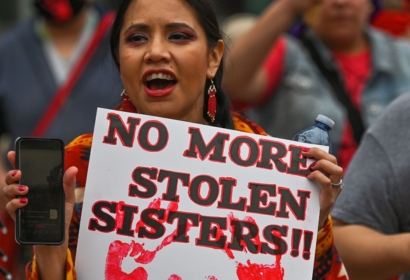

No More Stolen Sisters: Justice for the missing and murdered Indigenous women of Canada
"There can be no piecemeal solution to a tragedy of this scale." – 2011 joint statement of Indigenous and non-Indigenous organizations calling for action to stop violence against First Nations, Inuit and Metis women in Canada
According to Canadian government statistics, Indigenous women are five times to seven times more likely than other women to die as the result of violence. The Native Women's Association of Canada has documented more than 580 cases of missing and murdered Indigenous women in Canada, most within the last three decades. Because of gaps in police and government reporting, the actual numbers may be much higher.
Canadian police and public officials have also long been aware of a pattern of racist, sexist violence against First Nations, Inuit and Metis women in their homes and on the streets. But government response has been shockingly out of step with the scale and severity this tragedy.
The pattern looks like this:
- Racist and sexist stereotypes deny the dignity and worth of Indigenous women, encouraging some men to feel they can get away with violent acts of hatred against them.
- Decades of government policy have impoverished and broken apart Indigenous families and communities, leaving many Indigenous women and girls extremely vulnerable to exploitation and attack.
- Many police forces have failed to institute necessary measures – such as training, appropriate investigative protocols and accountability mechanisms – to eliminate bias in how they respond to the needs of Indigenous women and their families.
A movement for truth and justice
Across Canada, families of missing and murdered Aboriginal women are being joined by supporters from all walks of life to honour the lives of all those sisters, daughters, mothers and grandmothers tragically taken from us – and to demand action. Amnesty International is proud to be part of this movement. Along with a wide range of Indigenous peoples' organizations, human rights groups, labour unions and faith communities, we have called call for a comprehensive national action plan to stop violence against women. Such a national action plan must:
- Ensure Indigenous women's access to justice, including effective and unbiased police response to all cases of missing and murdered women and new investigations of cases where police misconduct has occurred;
- Improve public awareness and accountability through the consistent collection and publication of national statistics on rates of violent crime against Indigenous women;
- Provide adequate, stable funding to the frontline organizations that provide culturally-appropriate services such as shelter, support and counseling for Indigenous women and girls and their communities;
- Address the root causes of violence against Indigenous women, including by closing the economic gap between Indigenous and non-Indigenous people;
- Eliminate inequalities in the services available to Aboriginal children, in particular, through the child welfare system.
The federal government has responded by:
- Announcing plans to spend $10 million over five years to address violence against Aboriginal women and girls -- although most of the money is going toward police initiatives that track missing persons in general, without any particular focus on the specific patterns of violence against Indigenous women.
- Delaying funding to the Native Women’s Associations of Canada’s “Sisters in Spirit” initiative, important research and advocacy work that the government itself has said has been vital in drawing attention to violence against Aboriginal women.
- Refusing to develop a comprehensive national action plan on stopping violence women and girls – even though Canada has played a key in United Nations resolutions promoting such national action plans as a standard for all nations to adopt.
The high rates of violence faced by Indigenous women in Canada is a national human rights tragedy – one that requires us all to speak out loudly and clearly so that government will finally listen.
Photo: Activists stand vigil on Parliament Hill in Ottawa, 4 October 2012, to remember the missing and murdered Indigenous women in Canada. Susanne Ure/Amnesty International
Recommended Links
FIMI: International Indigenous Women's Forum
Native Youth Sexual Health Network
Native Womens' Association of Canada